KEY IDEA核心观点
Autonomy in space science should be measured by valid scientific return across complete campaigns—task coverage, intervention costs, and evidence integrity—not by distance driven or inferences computed.太空科学中的自主性,应该用完整科学考察中的有效科学产出来衡量——任务覆盖、干预成本与证据完整性——而不是行驶里程或推理次数。
From analyzing data to running experiments从分析数据到执行实验
AI for science is moving from interpreting existing data toward designing and executing experiments. A model that predicts a molecular property can be valuable without touching an instrument; a system that selects an experiment must connect its prediction to a feasible physical intervention and an interpretable outcome.AI for Science 正在从解读已有数据,走向设计与执行实验。预测分子性质的模型可以不接触任何仪器就产生价值;而一个能选择实验的系统,必须把预测连接到可行的物理干预和可解释的结果上。
Space sharpens this transition. Microgravity and extraterrestrial environments expose phenomena that terrestrial experiments cannot fully reproduce—yet samples are finite, resources constrained, and opportunities to intervene rare.太空让这种转变更加尖锐:微重力与地外环境能展现地面实验无法完全复现的现象,但样本有限、资源受限、干预机会稀少。
What orbital laboratories already show轨道实验室已经证明的事
Across orbital biology, materials, and fluid and thermal physics, the ability to extract hypotheses from flight data has advanced alongside—yet often separately from—the ability to acquire those data autonomously. Preparing organisms, maintaining cultures, delivering perturbations, and preserving samples remain the binding constraints.在轨道生物、材料、流体与热物理实验中,从飞行数据中提炼假设的能力在进步,但往往与自主获取数据的能力相互脱节。制备与复苏生物样本、维持培养条件、施加扰动、保存样品,这些才是真正的约束。
The review's caution runs both ways: dedicated apparatus already performs sophisticated unattended work, so a robot must justify its value against dedicated mechanisms, redundancy, and human-supported operation—not against an empty bench.综述的提醒是双向的:专用自动化装置已经能完成复杂的无人值守工作,因此机器人必须证明自己相对专用机构、冗余设计和人在回路支持的增量价值,而不是与一个空实验台作比较。
Planetary fieldwork, where decisions are irreversible行星实地科考:决策不可逆
Planetary in situ science couples interpretation to an unusually constrained measurement process: an outcrop may be observable only during one traverse, a chemical analysis consumes material, a sample can lose its context during collection. The unit of autonomy is a scientific decision together with the observation or intervention that implements it.行星原地科学把数据解读与极度受限的测量过程绑在一起:一块露头可能只在某次巡视中可见,一次化学分析会消耗样品,样本在采集转移中可能丢失上下文。自主的最小单位,是一个科学决策连同实现它的观测或干预。
Recovery cases show both edges. Curiosity resumed sample acquisition through ground-developed feed-extended drilling; arm assistance could not rescue InSight's HP3 penetrometer. Interventions can save an experiment—or introduce new failure modes.救援案例展示了两个极端:好奇号通过地面研发的进给扩展钻进恢复了采样能力;而机械臂辅助未能挽救洞察号的 HP3"鼹鼠"。干预可以挽救实验,也可能引入新的故障模式。
What terrestrial self-driving labs teach地面自动驾驶实验室的启示
Terrestrial laboratories demonstrate three partly independent routes to experimental autonomy: algorithms that choose informative experiments, hardware that executes repeatable operations, and infrastructure connecting instruments, data, and people. Closed-loop systems accelerated formulation search—but replenishment, calibration, and reliable execution still bound what unattended operation can sustain.地面实验室展示了三条相对独立的实验自主路径:选择信息量最大实验的算法、执行可重复操作的硬件、以及连接仪器与数据的基础设施。闭环系统加速了配方搜索,但耗材补充、标定与可靠执行,仍然限制着无人值守运行能支撑多久。
Negative results and invalid evidence are part of the record. A space deployment inherits these failure modes and adds its own—so protocols, provenance, and independent validation need to be designed in from the start.负结果与无效证据也是记录的一部分。太空部署会继承这些故障模式并叠加新的模式——因此实验规程、数据溯源与独立验证必须从一开始就设计进去。
A framework for sustained scientific campaigns走向持续的具身科学考察
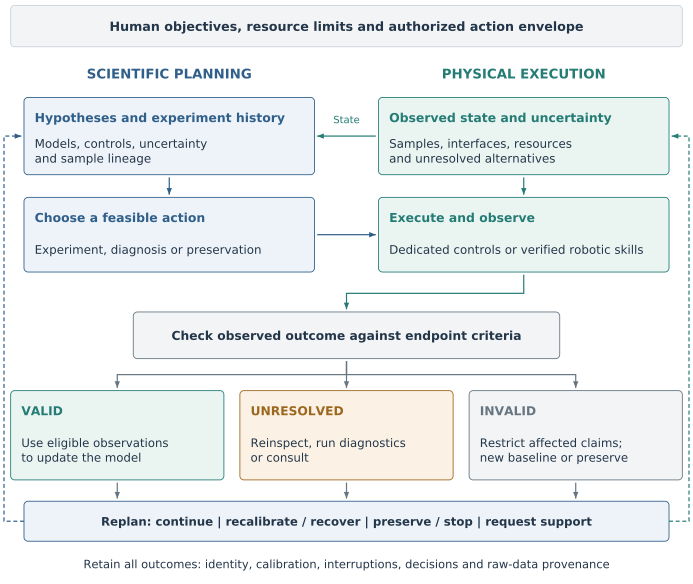
The synthesis connects four accounts: sample history, scientific decisions, physical execution, and claim-specific validity. A worked orbital design, a planetary extension, and matched evaluation schemes separate what sensing, decision policies, and physical actions each contribute.综述提出的框架连接四条线索:样本历史、科学决策、物理执行与命题级有效性。一个轨道设计案例、一个行星扩展方案,以及配套的评估方法,把感知、决策策略与物理动作各自的贡献分开计量。
The agenda that follows measures autonomy through valid scientific return, task coverage, intervention costs, and evidence integrity across complete campaigns. That is the yardstick space robots will have to meet.由此形成的研究议程,用完整科学考察中的有效科学产出、任务覆盖、干预成本与证据完整性来衡量自主性。这正是太空机器人必须通过的标尺。
SOURCE & FURTHER READING来源与延伸阅读
AI for Science in Space: Orbital Laboratories, Planetary Fieldwork, and Embodied Autonomy太空中的 AI for Science:轨道实验室、行星实地科考与具身自主
This column is an editorial adaptation, not a full translation or a new experimental report. The complete English manuscript contains the methods, study-specific qualifications, and bibliography. Figures retain their original English labels.本文为技术专栏改编,并非逐字全文翻译,也不是新的实验报告。完整英文稿件包含方法、各项研究的适用条件及参考文献。插图保留原始英文标注。
Source: arXiv:2610.39689, 29 Oct 2026.来源:arXiv:2610.39689,2026 年 10 月 29 日。