THE CENTRAL IDEA核心观点
The transfer test is a completed physical task—including contact, stabilization, and recovery.迁移能力的检验,应是一项完整的物理任务,包括接触、稳定与恢复。
Knowledge must cross a physical interface知识必须跨过物理接口
A foundation model can interpret an instruction, recognize an object, or reuse a learned behavior. For a space robot, those abilities become useful only when the output reaches an execution system with the right coordinates, units, timing, and physical assumptions. The review follows this path from perception and prediction through planning and action to validation.基础模型可以理解指令、识别物体或复用学习到的行为。对空间机器人而言,只有当输出以正确的坐标系、单位、时序和物理假设进入执行系统时,这些能力才真正有用。这篇综述沿着感知与预测、规划与动作,再到验证的路径展开讨论。
Several interfaces are possible. A model can issue numerical targets, select existing skills, generate constraints for a planner, predict action sequences, or represent possible future states. Each places physical responsibility somewhere different. A skill library inherits the behavior of its controllers; a learned action policy inherits the dynamics and action conventions represented in its training data.模型可以采用多种接口:输出数值目标、选择已有技能、为规划器生成约束、预测动作序列,或表征可能的未来状态。不同接口把物理执行责任放在不同位置。技能库继承其控制器的行为,学习式动作策略则继承训练数据中体现的动力学和动作约定。
A moving arm also moves its spacecraft机械臂运动,也会推动航天器本体
On a fixed terrestrial robot, a workbench or floor supplies a familiar support condition. On a free-floating spacecraft, arm motion reacts on the base. Replaying a terrestrial end-effector trajectory changes spacecraft motion and control-resource demand. The action can have the same numerical representation and a different physical consequence.在地面固定式机器人中,工作台或地面提供了熟悉的支撑条件。在自由漂浮航天器上,机械臂运动会反作用于基座。重放一条地面末端轨迹,会改变航天器运动与控制资源需求。同样的动作数值表达,可能产生不同的物理后果。
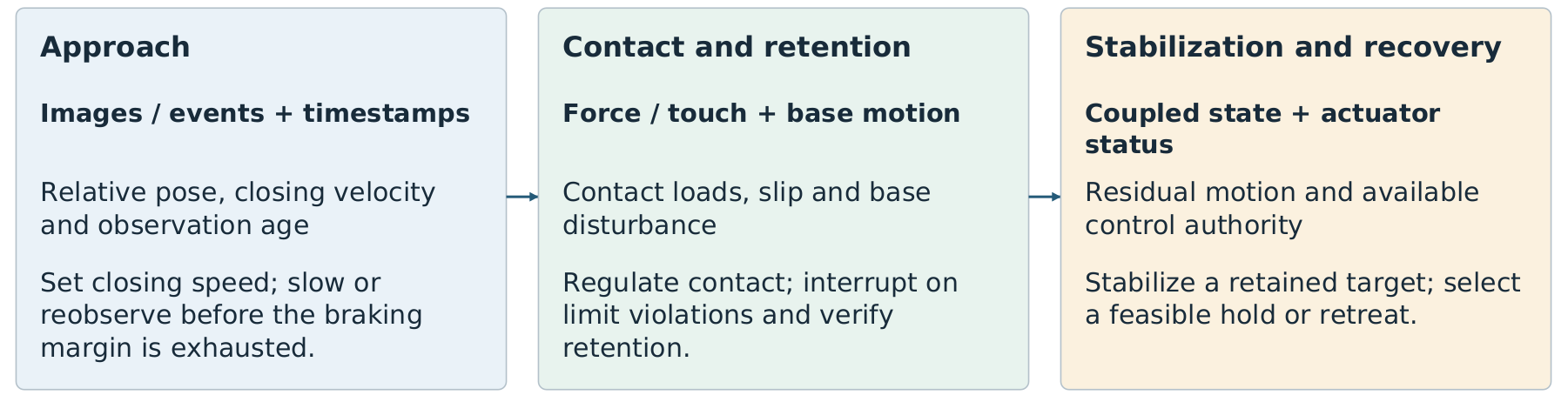
Capture changes the system again. After contact, the client becomes part of a coupled mechanical interaction. Contact may dissipate kinetic energy, but internal forces cannot remove total momentum. Reaching a grasp pose therefore differs from retaining the grasp and stabilizing the combined system.捕获会再次改变系统。接触之后,目标航天器进入耦合的机械相互作用。接触可以耗散动能,但内力无法消除系统总动量。因此,到达抓取位姿,与保持抓取并稳定组合系统,是不同的任务阶段。
The paper identifies three places for adaptation: condition the model on relevant base and relative-motion state; adapt training to changed inertia, momentum, and contact; or modify the external controller that interprets proposed actions. These routes can be combined, but their effects should be tested separately before attributing a gain to the model.论文指出了三个适应位置:向模型提供相关基座状态与相对运动状态;让训练覆盖惯量、动量与接触条件的变化;或者调整解释候选动作的外部控制器。这些路径可以组合使用,但在将收益归因于模型之前,应先分别检验各自作用。
More actions per second do not guarantee fresher feedback动作吞吐量更高,不一定意味着反馈更新鲜
Action chunking generates multiple future commands in one inference call. It can raise action throughput while the policy continues to execute from an older observation. Query latency, command rate, and the interval before fresh observations influence the policy are distinct measurements.动作分块在一次推理中生成多个未来指令。它可以提高动作吞吐量,但策略可能仍依据较早的观测继续执行。单次查询延迟、指令输出频率,以及新观测再次影响策略之前的时间间隔,是不同的指标。
The review discusses methods that overlap inference and execution, and methods that use a faster decoder with fresh tactile or force feedback within a chunk. These mechanisms address different parts of the delay. They still require an interrupt or recovery path when a contact assumption fails.综述讨论了推理与执行重叠的方法,以及在动作块内部利用最新触觉或力反馈的快速解码器。这些机制处理的是延迟链路中的不同部分。当接触假设失效时,系统仍需要中断或恢复路径。
For an approaching spacecraft, clearance must accommodate pose error, motion during sensing and computation, tracking error, and braking distance. A higher model throughput helps only if that improvement reaches this physical timing budget. A local controller may close a fast loop even while the high-level model updates slowly.对正在接近目标的航天器,安全间隙必须覆盖位姿误差、感知与计算期间的运动、跟踪误差和制动距离。更高的模型吞吐量,只有真正改善了这份物理时间预算才有意义。即便高层模型更新较慢,本地控制器仍可能维持快速闭环。
Event sensing and spiking computation need system tests事件感知与脉冲计算,需要系统级检验
Event cameras report brightness changes and can offer timely observations in fast motion or strong illumination contrast. Spiking neural networks offer a route to sparse computation. The two are complementary design choices, but neither automatically establishes a better navigation or manipulation system.事件相机报告亮度变化,在快速运动或强光照反差下可能提供及时观测。脉冲神经网络则提供稀疏计算的实现路径。两者是互补的设计选项,但任何一项都不会自动构成更好的导航或操作系统。
Encoding, preprocessing, memory traffic, inference, and command execution determine whether a sensing advantage survives. Estimated arithmetic energy differs from measured task energy. A model evaluated with synthetic events or ideal target crops also answers a narrower question than a complete detector and estimator operating with physical sensors.编码、预处理、内存访问、推理与指令执行,共同决定感知优势能否保留下来。估算的运算能耗与测量的任务能耗并不相同。基于合成事件或理想目标裁剪的模型评估,回答的问题也比真实传感器下的完整检测与估计链路更有限。
The comparison should keep tasks, priors, adaptation budgets, and computing boundaries aligned. Changes in model capacity or pretrained encoders can otherwise be mistaken for an advantage of the neural representation itself.比较时应对齐任务、先验信息、适应预算和计算边界。否则,模型容量或预训练编码器的变化,可能被误认为神经表示形式本身的优势。
Separate generalization from adaptation把泛化与适应分开检验
A frozen model solving an unseen task tests generalization under its available interfaces. Updating a policy, revising task instructions, or tuning a controller using target-domain interaction tests adaptation. Both can be valuable, but a report should identify what changed, how much interaction was used, and what knowledge was reused.冻结模型通过已有接口解决未见任务,检验的是泛化。利用目标域交互更新策略、修订任务指令或调整控制器,检验的是适应。两者都有价值,但报告应说明改变了什么、使用了多少交互,以及复用了哪些知识。
The proposed sim-to-ground-to-space pathway uses physical tests and telemetry to diagnose discrepancies, followed by closed-loop revalidation. A crossed evaluation can vary task novelty and physical novelty independently. It then measures whether performance survives new inertia, contact conditions, or task combinations within a stated adaptation budget.论文提出的“仿真—地面—空间”路径,通过物理试验与遥测诊断差异,再进行闭环重新验证。交叉评估可以独立改变任务的新颖程度与物理条件的新颖程度,随后检验在明确的适应预算下,性能能否跨越新惯量、接触条件或任务组合。
A complete capture test records approach, contact, retention, stabilization, and failed attempts. It also records operator interventions, feedback timing, total energy, and sustained thermal behavior. That evidence connects reusable model knowledge to the work a space robot can actually complete.完整的捕获测试应记录接近、接触、保持、稳定与失败尝试,同时记录操作员干预、反馈时序、总能耗及持续热表现。这样的证据,才能把模型中的可复用知识与空间机器人实际完成的工作联系起来。
SOURCE & FURTHER READING来源与延伸阅读
Foundation Models for Autonomous Space Robotics: Architectures, Physical Adaptation, and Validation自主空间机器人的基础模型:架构、物理适应与验证
This column is an editorial adaptation, not a full translation or a new experimental report. The complete English manuscript contains the methods, study-specific qualifications, and bibliography. Figures retain their original English labels.本文为技术专栏改编,并非逐字全文翻译,也不是新的实验报告。完整英文稿件包含方法、各项研究的适用条件及参考文献。插图保留原始英文标注。
Source: local final manuscript, 16 Oct 2026. Equivalence with externally uploaded versions has not been verified.来源:本地 2026 年 10 月 16 日定稿;尚未核验与外部上传版本的一致性。