THE CENTRAL IDEA核心观点
Accept a task only when its motion, resource use, and recovery remain feasible together.只有当运动、资源使用与恢复方案同时可行时,才接受一项任务。
The body changes the decision物理机体会改变决策
A space robot can plan a collision-free motion and still be unable to carry it out. A joint may be too cold, a battery may not supply the peak current, or attitude control may have too little remaining authority. A more accurate perception model may also increase execution time and processor heat. These connections motivate the review's resource-aware view of embodied autonomy.空间机器人可以规划出一条无碰撞运动,却仍无法执行。关节可能过冷,电池可能无法提供峰值电流,姿态控制也可能缺少剩余控制能力。更准确的感知模型,还可能增加执行时间和处理器发热。这些关联构成了论文对资源感知具身自主性的讨论起点。
Embodiment concerns how sensing, structure, and dynamics shape behavior. Autonomy concerns which decisions can be made without immediate human direction. Learning estimates models or policies from data. These properties overlap without being interchangeable: conventional control can use rich physical feedback, and a trained neural controller can keep fixed parameters for an entire mission.具身性关注感知、结构与动力学如何塑造行为;自主性关注哪些决策可以不依赖即时人工指令;学习则从数据中估计模型或策略。这些属性彼此交叉,却不能互相替代:传统控制也可以利用丰富的物理反馈,训练好的神经控制器也可以在整个任务期间保持参数不变。
Make the resource contract explicit把资源条件写成明确接口
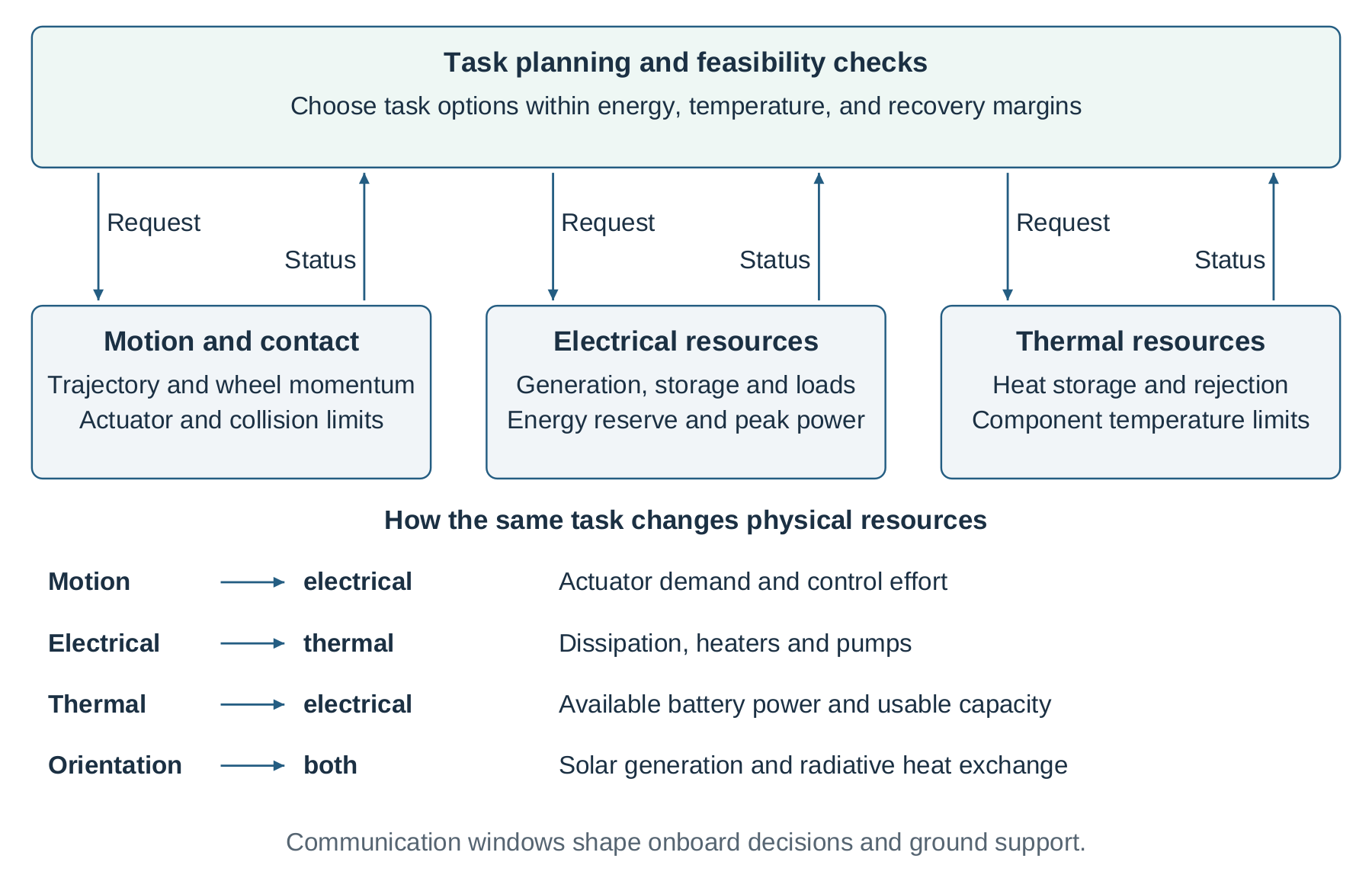
Task planning proposes activities and priorities. Resource management returns feasible load modes and timing. Motion control supplies trajectories and enforces fast attitude, proximity, and contact limits. Their shared interface must carry usable constraints, not just isolated subsystem measurements.任务规划提出活动与优先级,资源管理返回可行负载模式与时机,运动控制提供轨迹,并执行快速姿态、邻近运动和接触约束。它们的共享接口应传递可直接使用的约束,而不只是各子系统的孤立测量值。
Stored energy, allowable discharge power, component temperatures, and reaction-wheel momentum all constrain a candidate activity. Battery temperature and health affect the energy that can actually be used. A reserve must account for expected battery conditions and the energy needed for a safe transition.储存能量、允许放电功率、部件温度与反作用飞轮动量,都约束着候选活动。电池温度和健康状态会影响真正可用的能量。储备量既要考虑预期电池条件,也要覆盖安全转换所需的能源。
Timing belongs in this contract. Fast motion and protection loops operate independently of slower forecasts. If scheduling misses a deadline, command arbitration needs an approved plan or a defined safe transition. Recovery must begin while sufficient control authority and resources remain.时序也属于这份接口约定。快速运动与保护回路应独立于较慢的预测运行。如果调度错过截止时间,指令仲裁需要保留已批准方案,或者选择明确的安全转换。恢复动作必须在控制能力与资源仍然充足时启动。
Lower power is only half the calculation更低功率,只完成了一半计算
Energy is power integrated over time. A processor with lower power draw can consume more energy per inference if it runs sufficiently slowly. Meaningful comparisons also include preprocessing, memory, idle periods, and any extra attempts caused by a reduction in model accuracy.能量是功率对时间的积分。如果运行时间足够长,功率更低的处理器反而可能消耗更多单次推理能量。有意义的比较还应包括预处理、内存访问、空闲时段,以及模型精度下降造成的额外尝试。
The spacecraft cares about completed work within constraints: whether a perception result arrives before the next control decision, whether peak current is available, and whether sustained operation stays within temperature limits. Processor power alone does not answer these questions.航天器关心的是约束范围内完成了多少工作:感知结果能否在下一次控制决策前到达,峰值电流是否可用,持续运行是否处于温度限制之内。仅凭处理器功率,无法回答这些问题。
Forecasting has a similar dependency on context. In the paper's illustrative margin example, a predicted peak of 79 °C against an 80 °C limit leaves little confidence if errors are typically 2 K. An average error is not a safety bound. The planner needs uncertainty characterized for its operating conditions, or a conservative alternative when those conditions are unfamiliar.预测也同样依赖上下文。论文给出的裕量示例中,如果上限是 80 °C、预测峰值为 79 °C,而典型误差为 2 K,那么剩余裕量就很有限。平均误差不是安全边界。规划器需要针对运行条件描述的不确定性;当遇到陌生条件时,则需要保守的替代方案。
Three choices before eclipse进入地影前的三个选择
Consider the review's illustrative servicer preparing to capture a non-cooperative client before eclipse. The battery must support approach, contact, and recovery; the processor has limited heat rejection. Three options are available: capture now at full workload, capture now while deferring optional processing and communications, or wait for another opportunity. Navigation and collision avoidance continue in all three.考虑综述中的示例:一艘服务航天器准备在进入地影前捕获非合作目标。电池必须支持接近、接触与恢复,处理器的散热能力也有限。此时有三个选项:以完整负载立即捕获;推迟可选处理与通信、立即捕获;或者等待下一次机会。三个选项都持续保留导航与避碰功能。
The full-workload option may retain enough energy yet exceed the processor's thermal limit after forecast error is included. The reduced-workload option can use the same geometric trajectory while reducing heat. If it also meets battery-power, reserve, and wheel-momentum limits, it can preserve the current capture window.完整负载方案可能仍有足够能量,却在计入预测误差后超出处理器热限。降低可选负载的方案可以沿用同一条几何轨迹,同时减少发热。如果它也满足电池功率、储备和飞轮动量限制,就可能保住当前捕获窗口。
Waiting buys time to cool or recharge, but also incurs station-keeping and waiting loads. It must be evaluated from the state the system will reach after waiting. During execution, measurements update forecasts; optional loads can stop first, followed by a feasible hold or retreat if margins continue to shrink. This is a design example, not a reported flight outcome.等待能够争取冷却或充电时间,但也会带来保持轨道及等待期间的负载。评估等待方案时,应从等待结束后的系统状态出发。执行过程中,测量不断更新预测;先停止可选负载,若裕量继续缩小,则进入可行的保持或撤离。这是设计示例,并非已报告的飞行结果。
A supervisor must match the process timescale监督节奏需要匹配物理过程
A higher-level reasoning system can influence a slower physical process without issuing every actuator command. But the information window and response delay must match that process. The review describes ASTREA computing-load experiments in which supervisory analysis windows produced different thermal-control outcomes; the shorter window performed worse than the RL-only baseline in the reported comparison, while an orbit-aligned longer window improved the reported measures.高层推理系统无需发出每一条执行器指令,也能影响较慢的物理过程。但其信息窗口和响应延迟必须与过程匹配。综述介绍的 ASTREA 计算负载实验中,不同监督分析窗口产生了不同热控结果:在报告的比较中,较短窗口表现差于仅使用强化学习的基线,而与轨道周期对齐的较长窗口改善了所报告的指标。
The lesson concerns supervisory timing within a bounded experiment. It does not establish that a particular model or update frequency is universally better. A thermal process, a contact controller, and a mission scheduler have different information needs and deadlines.这个结果说明的是特定实验范围内的监督时序作用,并不证明某类模型或某个更新频率普遍更优。热过程、接触控制器与任务调度器有不同的信息需求和截止时间。
The next useful comparisons should measure which decisions a forecast changes, how much complete-task energy an implementation consumes, and whether recovery remains feasible. This connects algorithm performance to additional observations, maneuvers, or operating time on a real platform.下一步有价值的比较,应衡量预测改变了哪些决策、某种实现消耗多少完整任务能量,以及恢复是否仍然可行。这样才能把算法性能与实际平台上增加的观测、机动或运行时间联系起来。
SOURCE & FURTHER READING来源与延伸阅读
Resource-Aware Embodied Autonomy for Space Robots: A Review太空机器人的资源感知具身自主性综述
This column is an editorial adaptation, not a full translation or a new experimental report. The complete English manuscript contains the methods, study-specific qualifications, and bibliography. Figures retain their original English labels.本文为技术专栏改编,并非逐字全文翻译,也不是新的实验报告。完整英文稿件包含方法、各项研究的适用条件及参考文献。插图保留原始英文标注。
Source: local final manuscript, 16 Oct 2026. Equivalence with externally uploaded versions has not been verified.来源:本地 2026 年 10 月 16 日定稿;尚未核验与外部上传版本的一致性。