THE CENTRAL IDEA核心观点
Evaluate the complete decision chain: measurement → estimate → plan → command → physical response.评估完整决策链:测量 → 估计 → 规划 → 指令 → 物理响应。
A useful model needs a place in the loop有用的模型,需要明确的系统位置
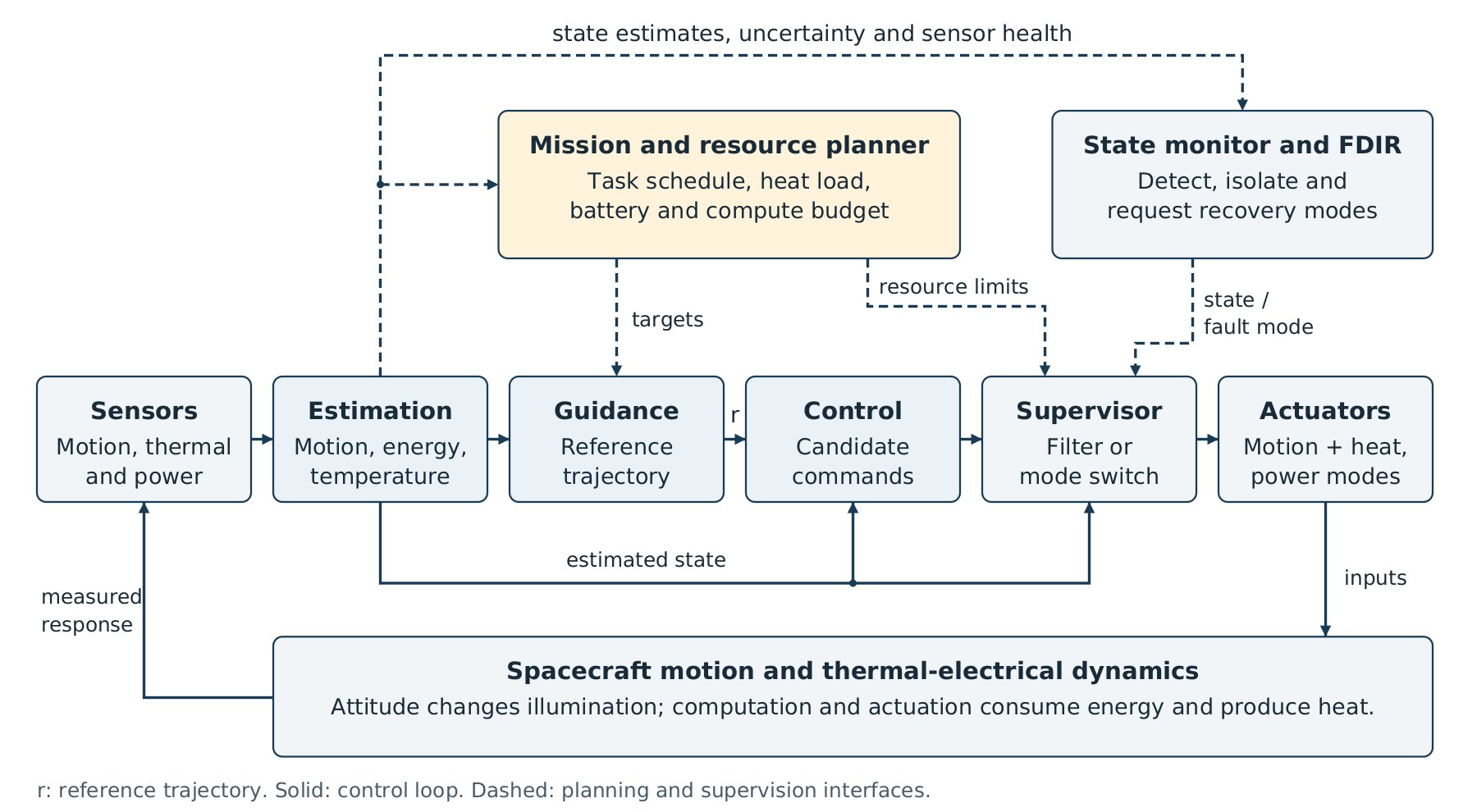
A spacecraft does not experience a neural network as a benchmark score. It experiences the resulting state estimate, maneuver, actuator demand, and heat load. A model that predicts a visually convincing pose can still produce a state inconsistent with the vehicle's motion. A fast trajectory proposal can still violate a thrust or pointing constraint. The survey therefore asks how learned functions work within the rest of the flight system.航天器面对的不是神经网络的榜单分数,而是由此产生的状态估计、机动动作、执行器需求和热负载。一个视觉上合理的位姿预测,仍可能与飞行器运动不一致;一个快速生成的轨迹方案,仍可能违反推力或指向约束。因此,这篇综述关注学习模块如何与飞行系统的其他部分协同工作。
The recurring architecture is modular. Learning extracts image features, supplies a prediction, or proposes a candidate solution. Geometry, filtering, optimization, and feedback control then turn that output into an executable decision. This arrangement makes the contribution of a learned component easier to isolate and its limitations easier to test.反复出现的架构是模块化组合:学习方法提取图像特征、提供预测或生成候选解,再由几何求解、滤波、优化与反馈控制将其转化为可执行决策。这样的组合使学习模块的具体贡献更容易被识别,其局限也更容易被测试。
Navigation: follow the image all the way to state导航:从图像一直追踪到状态估计
Relative navigation around a non-cooperative target illustrates why interfaces matter. A learned detector or keypoint network provides observations; a geometric solver recovers pose; a temporal estimator checks consistency over time. Recognition, single-image pose estimation, and tracking solve different problems, even when they share a visual encoder.围绕非合作目标的相对导航,能清楚说明接口的重要性。学习式检测器或关键点网络提供观测,几何求解器恢复位姿,时序估计器检验跨时刻的一致性。即便共用视觉编码器,目标识别、单帧位姿估计与跟踪也仍是不同任务。
The survey's SPNv2 example separates an offline model improvement from later adaptation using unlabeled laboratory images. It also identifies archived PRISMA flight images that were processed on the ground. These distinctions matter: evaluation on flight imagery establishes a kind of data relevance, but does not by itself establish onboard execution or closed-loop flight performance.综述中的 SPNv2 案例区分了离线模型改进,以及随后利用无标签实验室图像进行的适应。同时,论文明确指出,其存档 PRISMA 飞行图像是在地面处理的。这个区分很重要:使用飞行图像说明数据具有一定任务相关性,但本身并不证明模型已在星上运行,更不等于完成了在轨闭环验证。
For deployment, ask which target geometry is known, how detections are obtained, how uncertainty enters the estimator, and what happens to rare large errors. A second camera, a wireframe model, and a learned shape prior each supply different information. Their costs and assumptions belong in the comparison.面向部署,应追问已知哪些目标几何信息、检测结果如何获得、不确定性如何进入估计器,以及少数大误差会带来什么后果。第二台相机、线框模型和学习到的形状先验提供的是不同信息,其成本与假设都应纳入比较。
Guidance and control: a proposal still needs checking制导与控制:候选方案仍需验证
Trajectory prediction can accelerate an optimizer by providing a useful initial guess. In that role, the downstream solver remains responsible for the adopted dynamics and constraints. The meaningful measurements include final feasibility, solution time, fuel or energy use, and the cost of unsuccessful proposals—not merely network inference time.轨迹预测可以提供有效初值,从而加速优化器。在这种分工下,下游求解器仍需处理所采用的动力学和约束。真正有意义的指标包括最终可行性、求解时间、燃料或能源消耗,以及失败候选方案的代价,而不仅是网络推理耗时。
Learned feedback control has a more direct relationship with the vehicle. The survey discusses LeLaR as evidence of learned attitude control in orbit, while emphasizing the calibration, sensing, and monitoring needed around the controller. The surrounding engineering determines what the experiment demonstrates and where the result applies.学习式反馈控制与飞行器的关系更直接。综述将 LeLaR 作为学习式姿态控制在轨实验的案例,同时强调控制器外围的标定、感知与监测工作。正是这些配套工程,决定了实验能够说明什么,以及结论适用于哪些条件。
A useful evaluation must include actuator saturation, uncertain inertia, observation errors, and asynchronous execution. A protective supervisor also needs a feasible backup action and enough time to complete it. Intervention counts and recovery outcomes reveal behavior that an average tracking error can conceal.有用的评估必须覆盖执行器饱和、惯量不确定性、观测误差和异步执行。保护性监督机制还需要可行的备用动作,以及完成该动作所需的时间。干预次数与恢复结果,能够揭示平均跟踪误差掩盖的行为。
Thermal prediction changes what a maneuver costs热预测改变了对机动代价的理解
Computing, pointing, and motion share a physical platform. A change in attitude alters solar exposure and power generation. A larger inference workload increases processor demand and heat. An operational decision therefore has thermal and electrical consequences as well as a geometric trajectory.计算、指向与运动共用同一个物理平台。姿态变化会改变太阳照射和发电条件,更大的推理负载会增加处理器功耗与发热。因此,一个运行决策既对应几何轨迹,也带来热学与电学后果。
Thermal surrogates can make repeated prediction cheaper. Steady-state models support design sweeps; recurrent models capture temperature histories; transfer learning can correct discrepancies using flight measurements. Prediction accuracy must be interpreted against the available component margin and the timing of the temperature peak. A low average error is not an upper bound on the next error.热代理模型可以降低反复预测的成本。稳态模型支持设计参数扫描,循环模型描述温度历史,迁移学习则可利用飞行测量修正偏差。预测精度必须结合部件剩余温度裕量和温度峰值出现的时间解释。较低的平均误差,并不构成下一次误差的上界。
A predictor also cannot create cooling authority that the hardware lacks. Radiators, conductive paths, heaters, and available operating modes define what a scheduler can actually change. Closing the loop requires testing both the forecast and the physical response to the proposed schedule.预测器也无法创造硬件并不具备的散热能力。散热器、导热路径、加热器与可用运行模式,限定了调度器实际能够改变什么。要实现闭环,就必须同时检验预测结果,以及系统对所提调度方案的物理响应。
Read the evidence along three axes沿着三个维度阅读证据
Keep three questions separate: where did the data come from, where did the software run, and what authority did it have? Synthetic images, laboratory measurements, and flight telemetry describe the data. A workstation, target processor, and spacecraft describe execution. Advisory predictions and actuator commands describe authority. One label such as ‘space-tested’ cannot replace these details.需要分开回答三个问题:数据来自哪里,软件在哪里运行,它具有什么控制权限?合成图像、实验室测量与飞行遥测描述数据来源;工作站、目标处理器与航天器描述执行位置;建议性预测与执行器指令描述控制权限。一个“经过空间测试”的标签无法替代这些细节。
The survey's practical progression is to reproduce a bounded task, validate the deployed implementation, test the coupled system, demonstrate restricted operational use, and then evaluate controlled updates. At every stage, retain failure cases and a comparable baseline. The question is whether learning enables more useful work under the same mission constraints.综述提出的实践路径依次是:复现边界明确的任务,验证实际部署实现,测试耦合系统,开展受限运行验证,再评估受控更新。每个阶段都应保留失败案例和可比基线。最终要回答的是:在相同任务约束下,学习方法是否使系统完成了更多有用工作。
SOURCE & FURTHER READING来源与延伸阅读
AI for Space: A Survey of Guidance, Navigation, Control, and Thermal Management面向空间的人工智能:制导、导航、控制与热管理综述
This column is an editorial adaptation, not a full translation or a new experimental report. The complete English manuscript contains the methods, study-specific qualifications, and bibliography. Figures retain their original English labels.本文为技术专栏改编,并非逐字全文翻译,也不是新的实验报告。完整英文稿件包含方法、各项研究的适用条件及参考文献。插图保留原始英文标注。
Source: local final manuscript, 16 Oct 2026. Equivalence with externally uploaded versions has not been verified.来源:本地 2026 年 10 月 16 日定稿;尚未核验与外部上传版本的一致性。