THE CENTRAL IDEA核心观点
Do not replace a qualified attitude controller with a learned one. Train a selector that activates a faster continuation policy only in contexts where paired simulation shows it beats the baseline—and executes the unchanged baseline everywhere else.不要用学习型控制器整体替换合格的姿态控制器,而是训练一个选择器:只在成对仿真证明更优的情境中启用更快的继续策略,其余情境一律执行不变的基线。
The challenge: fast is good on average, risky per maneuver挑战:更快对平均误差有利,对单次机动未必
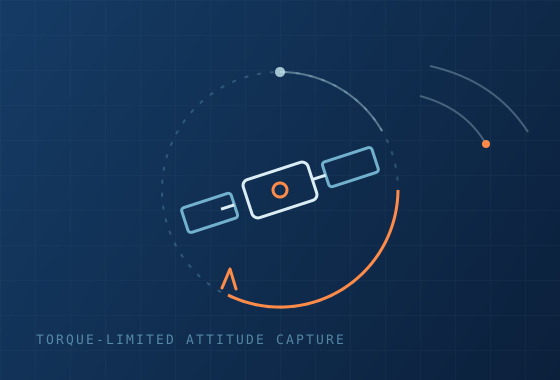
Torque-limited attitude capture is the final, decisive part of a slew: the spacecraft must arrive at the target attitude with near-zero body rates while reaction wheels or thrusters approach their authority limits. A more aggressive maneuver profile can shorten the capture and reduce average tracking error across a mission, but braking authority is uncertain—it shifts with inertia properties, momentum state, and actuator health. The same fast profile that helps most maneuvers can push an individual one past its ability to brake.力矩受限的姿态捕获是机动中决定性的一段:航天器必须以接近零的角速度到达目标姿态,而反作用轮或推力器正接近能力边界。更激进的机动剖面可以缩短捕获时间、降低全任务平均跟踪误差,但制动能力并不确定——它随惯量特性、动量状态和执行机构健康度变化。同一个在多数机动中占优的快速剖面,可能让某一次机动超出制动能力。
For a servicer approaching a client satellite, that trade-off cannot be resolved offline once and for all. Ground operators cannot be asked to re-tune capture gains per maneuver, and a conservative universal setting leaves real performance on the table during every short contact window. The paper frames this precisely: improving a controller that is already safe is a different problem from designing a controller from scratch.对于接近客户卫星的服务航天器,这种权衡无法一次性离线解决:不能要求地面操作人员针对每次机动重新整定捕获增益,而全域保守的设置又会在每个短暂窗口中浪费性能。论文把这个问题界定得很清楚:改进一个已经安全的控制器,与从零设计一个控制器,是两类不同的问题。
A baseline-relative learning problem基线相对的学习问题
The authors treat the existing capture controller as a fixed asset. The learning problem is not "find the best maneuver" but "decide, for this context, whether a faster alternative beats what we already trust." This reframing changes the loss: the metric that matters is the outcome difference between the modified and unchanged controller on the same maneuver, not the absolute tracking error of either. A modification that wins on average but loses on specific contexts is unacceptable for flight, so the optimization target is selective improvement with bounded regret per case.作者将现有捕获控制器视为固定资产。学习问题不是“找到最优机动”,而是“在当前情境下,更快的方案是否优于我们已信任的基线”。这一重构改变了损失函数:真正重要的指标是同一机动上修改版与原版控制器的结果之差,而不是任一方的绝对跟踪误差。对飞行任务而言,平均占优但在特定情境中变差的修改不可接受,因此优化目标是带单次回退约束的选择性改进。
This baseline-relative view also dictates the data discipline. Contexts used for training, validation, and calibration are kept disjoint, and the evaluation reports per-context outcomes rather than only pooled averages—17 improvements, 31 exact ties, and zero observed regressions for the selective controller. Reporting ties explicitly matters: a selector that cannot beat the baseline should be quiet, not creative.这种基线相对视角也决定了数据纪律:训练、验证与校准使用互不重叠的情境,评估按情境逐个报告结果而非只给合并均值——选择性控制器取得 17 项改进、31 项完全持平、零观测回退。明确报告持平很关键:一个无法战胜基线的选择器应该保持安静,而不是强行发挥。
Three mechanisms of paired-outcome learning成对结果学习的三个机制
The method combines three mechanisms. First, physically interpretable continuation policies: candidate modifications are alternative speed envelopes for the same capture law, so every candidate remains explainable in terms of braking margin and settling behavior rather than being a free-form network output. Second, separate prediction of task failure and of successful-pair tracking gains: the model estimates both whether a maneuver fails and how much the fast profile helps when both profiles succeed, because these two questions have different costs when wrong. Third, context-dependent rejection: if the predicted advantage is uncertain or absent, the system executes the unchanged baseline.该方法由三个机制组成。第一,物理可解释的继续策略:候选修改是同一捕获律的不同速度包络,每个候选都能用制动裕度和收敛行为解释,而不是自由形式的网络输出。第二,分别预测任务失败与成功对的跟踪增益:模型既估计机动是否失败,也估计在两种剖面都成功时快速剖面的收益——因为这两类问题判断错误的代价不同。第三,情境依赖的拒绝:当预测优势不确定或不存在时,系统执行不变的基线。
The rejection option is what makes the scheme flight-compatible. In effect, the learned component is a gate in front of a qualified controller: it can only say "yes, faster here" or "no comment." Ablations reported in the paper show no additional aggregate benefit from branch commitment, active querying, or score subtraction—suggesting the simple gated structure captures most of the available gain.拒绝选项是该方案能够上天的关键:学习组件本质上是合格控制器前的一道门,它只能说“这里可以更快”或“不表态”。论文消融实验显示,分支承诺、主动查询和分数相减都没有带来额外的总体收益——说明简单的门控结构已经捕获了大部分可用增益。
Paired simulation as the label source成对仿真作为标签来源
Labels come from complete paired simulations: for a given context, both the baseline and the candidate profiles are rolled out under common plant parameters and measurement seeds, so the comparison isolates the controller choice rather than noise. The Basilisk-based campaign uses 108 development contexts, 324 labeling rollouts, and 624 evaluation episodes across 48 held-out test contexts, including disclosed post-freeze diagnostics. Paired labels under shared randomness are what make per-context win/tie/loss accounting credible in the first place.标签来自完整的成对仿真:对给定情境,基线与候选剖面在相同的被控对象参数和测量种子下分别 rollout,比较结果只反映控制器选择而非噪声。基于 Basilisk 的实验包含 108 个开发情境、324 次标注 rollout,以及 48 个留出测试情境上的 624 个评估回合,并披露了冻结后的诊断信息。共享随机性的成对标签,使得逐情境的胜/平/负统计本身具有可信度。
For teams building similar pipelines, the transferable pattern is the pairing, not the simulator. Whatever high-fidelity environment hosts the attitude loop, labeling should compare candidates under identical disturbances and initial errors; otherwise the selector learns the noise structure of the test rig instead of the physics of the maneuver.对搭建类似流程的团队,可迁移的模式是“成对”而非某个仿真器:无论姿态回路运行在哪种高保真环境中,标注都应在相同扰动和初始误差下比较候选,否则选择器学到的是测试装置的噪声结构,而不是机动物理。
Results: fewer regressions, smaller but safer gains结果:回退更少,增益更小但更稳
The selective controller reduces aggregate integrated attitude error by 4.67% relative to the branch baseline, with 17 improved contexts, 31 exact ties, and no observed regressions. The aggressive alternative—always using the fast profile—achieves a 4.81% reduction but worsens 11 cases. The comparison is the paper in one sentence: the extra 0.14 points of average gain cost eleven individual regressions, which is precisely the trade a flight program usually refuses.选择性控制器相对分支基线将总积分姿态误差降低 4.67%,逐情境为 17 项改进、31 项持平、零观测回退。而始终使用快速剖面的激进方案可降低 4.81%,但有 11 个情境变差。这组对比就是论文的一句话总结:多出的 0.14 个百分点平均增益,代价是 11 次单次回退——而这正是型号任务通常拒绝的交易。
The authors are careful about the claim boundary: the evidence supports a restricted empirical trade-off between average improvement and individual regression, and does not establish a closed-loop safety guarantee. For adoption, that honesty is useful—it tells reviewers exactly which assurance gap must be closed by monitoring, envelopes, or formal methods before the gate can be trusted on orbit.作者对结论边界保持谨慎:证据支持的是“平均改进与单次回退之间受限的经验权衡”,并未构成闭环安全保证。对工程采用而言,这种坦诚有用——它明确告诉评审,在这道门能上天之前,还需用监控、包络或形式化方法补上哪一段保证缺口。
Where the gains appear—and where they do not增益出现在哪里,又在哪里消失
Improvements concentrate in principal-axis and near-axis maneuvers, at the braking boundary, and in selected noise/drift cases—contexts where the physics leaves exploitable margin. General coupled maneuvers retain the baseline. This pattern is physically plausible: when rotation axes couple strongly, uncertainty in braking authority grows, and the learned gate correctly stays closed. The map of where gains occur is therefore itself a deliverable: it tells operators which maneuver families are candidates for acceleration and which are not.改进集中在主轴与近轴机动、制动边界以及部分噪声/漂移情境——这些情境的物理结构留下了可利用的裕度。一般耦合机动则保留基线。这种模式在物理上合理:当旋转轴强耦合时,制动能力的不确定性增大,学习门正确地保持关闭。因此,“增益分布图”本身就是一项交付物:它告诉总体人员哪些机动族可以加速,哪些不行。
A subtle but important detail: 31 exact ties mean the selector frequently faces contexts where the fast profile is neither better nor worse. Treating ties as opportunities would inflate risk without reward; treating them as rejections keeps the system behavior dominated by the qualified controller. This is the right prior for any learning overlay on safety-relevant control.一个微妙但重要的细节:31 项完全持平意味着选择器经常面对快速剖面不好也不坏的情境。把持平当作机会会在没有收益的情况下放大风险;把持平当作拒绝,则让系统行为始终由合格控制器主导。对于任何叠加在安全相关控制之上的学习组件,这才是正确的先验。
Engineering mapping and evaluation boundaries工程映射与评估边界
Mapped to an onboard stack, the gate sits between mission planning and the attitude control loop: it reads the maneuver context (target attitude, momentum state, actuator status), evaluates the two predictors, and commits either the baseline or the fast continuation policy before the slew begins. Because candidates are speed envelopes of the same law, switching does not introduce a new control architecture onboard—the verification scope stays close to that of the qualified baseline, and the learned part can be wrapped in runtime monitors that freeze selection if context drifts outside the calibrated domain.映射到星上软件栈:这道门位于任务规划与姿态控制回路之间——读取机动情境(目标姿态、动量状态、执行机构状态),运行两个预测器,在机动开始前提交基线或快速继续策略。由于候选只是同一控制律的速度包络,切换并不在星上引入新的控制架构,验证范围与合格基线接近;学习部分还可包一层运行时监控,一旦情境漂出校准域即冻结选择。
A concrete evaluation plan for adoption: reproduce the paired-label pipeline on the target vehicle model; freeze the selector; then run shadow-mode evaluation across a context matrix that deliberately oversamples braking-boundary and coupled cases, reporting win/tie/loss per context with confidence intervals. Only after the no-regression result survives contexts the training campaign never saw should the gate move from advisory to active. The paper’s disclosed post-freeze diagnostics are a good template for that review.面向采用的可执行评估方案:在目标飞行器模型上复现成对标签流程;冻结选择器;随后在刻意超采样制动边界与耦合情境的情境矩阵上做影子模式评估,按情境报告胜/平/负及置信区间。只有当零回退结果在训练从未覆盖的情境中依然成立,这道门才应从建议模式转入激活模式。论文披露的冻结后诊断流程,可作为这类评审的模板。
SOURCE PAPER & REFERENCE MATERIAL原论文与参考资料
Paired-Outcome Learning for Selective Spacecraft Attitude Capture under Torque Limits
Donghe Chen, Jia Deng, Zehao Jia, Lin Cheng, Shengping Gong
arXiv preprint arXiv:2610.24763 · 2026