THE CENTRAL IDEA核心观点
Keep every vehicle’s trajectory planner independent and physics-complete. Move the coordination burden to two small learned outputs—spatial waypoints and ordered passage events—then train them end-to-end by differentiating through the planners themselves.让每架飞行器的轨迹规划器保持独立且物理完整,把协同负担转移到两个小型学习输出——空间路径点与有序通过事件——再通过穿过规划器的梯度端到端训练它们。
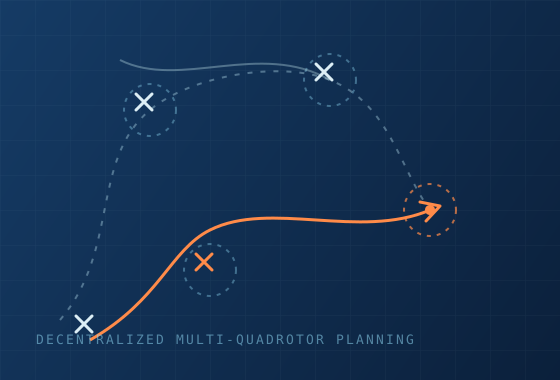
The challenge: coupled space, time, and interaction挑战:空间、时间与交互的三重耦合
Planning passage for multiple quadrotors means deciding, for each vehicle, which corridor to take and when to be there—under rigid-body dynamics and rotor-thrust bounds, while vehicles’ choices affect one another. Optimizing routes and passage times jointly couples temporal allocation, nonlinear motion, and inter-vehicle interaction into one problem. That coupling is exactly what makes centralized joint optimization expensive and brittle as the vehicle count grows, and what makes purely decentralized planning produce conflicts at shared passages.多旋翼通过规划要为每架飞行器决定走哪条通道、何时到达——在刚体动力学与旋翼推力约束下,且各机的选择互相影响。将空间路径与通过时间联合优化,会把时间分配、非线性运动和机间交互耦合成一个问题。这种耦合正是集中式联合优化随机数增加而昂贵且脆弱的原因,也是纯去中心化规划在共享通道处产生冲突的原因。
The same structure appears in orbit: multiple free-flying robots inspecting or assembling one structure must negotiate who passes which worksite first, without a ground station arbitrating in real time. The paper’s question—what is the smallest set of shared decisions that makes independent planners cooperate—is therefore directly relevant to multi-robot space operations, not only to drone swarms.同样的结构也出现在轨道上:多台自由飞行机器人围绕同一结构执行巡检或组装时,必须协商谁先通过哪个作业点,而地面站无法实时仲裁。因此论文的问题——让独立规划器产生协同所需的最小共享决策集是什么——与多空间机器人作业直接相关,不只是无人机集群问题。
Learn the interface, not the trajectory学习接口,而不是轨迹
The proposed framework is a learning-optimization hybrid. Neural networks predict spatial waypoints and ordered passage events; each vehicle then solves its own trajectory problem independently, conditioned on those shared predictions. The planners remain full rigid-body optimizers with thrust bounds, so feasibility is guaranteed by optimization rather than hoped for from a network. Learning supplies the coordination interface—the handful of discrete-ish decisions where vehicles actually interact—while physics stays where it belongs.论文提出学习-优化混合框架:神经网络预测空间路径点与有序通过事件,随后每架飞行器在这些共享预测的条件下独立求解自己的轨迹问题。规划器仍是带推力边界的完整刚体优化器,可行性由优化保证,而不是寄希望于网络输出。学习提供的是协同接口——少数几个机间真正相互影响的近似离散决策;物理则留在它该在的位置。
This division of labor is the architectural lesson. A monolithic learned policy would have to implicitly encode dynamics, actuation limits, and collision geometry in weights; here the network only encodes the cooperative structure, and the optimizer enforces everything physics can state explicitly. When a constraint changes—thrust derating after an actuator fault, for instance—the planner adapts by re-solving, without retraining the coordination networks.这种分工是架构层面的启示:单一端到端策略必须把动力学、执行约束和碰撞几何全部隐含进权重;而这里网络只编码协同结构,凡是物理能显式表达的都交给优化器强制执行。当约束变化时——例如执行机构故障后的推力降额——规划器通过重新求解即可适应,无需重训协同网络。
A shared time grid with locally optimized terminals公共时间网格与本地优化的终端
A common physical time grid aligns the vehicles: passage events predicted by the networks fix intermediate times on that grid, while terminal progress is optimized locally by each planner. This permits different vehicles to optimize different completion metrics—one may minimize time, another energy—without breaking the temporal alignment that keeps passages conflict-free. The design separates "when we meet the shared schedule" from "how each of us finishes."一个公共物理时间网格将各机对齐:网络预测的通过事件固定网格上的中间时刻,而终端进度由每个规划器本地优化。这使得不同飞行器可以优化不同的完成指标——一架最小化时间,另一架最小化能耗——同时不破坏保证通道无冲突的时间对齐。设计把“在共享调度上何时会合”与“各自如何完成”分开了。
For decentralized systems this is a pragmatic contract: only the event times cross vehicle boundaries, and everything downstream of them is local computation. Communication needs are modest and the failure mode is benign—if coordination messages are lost, each vehicle still holds a feasible local plan rather than half of a joint one.对去中心化系统而言,这是一个务实的契约:只有事件时刻跨越机体边界,其下游全部是本地计算。通信需求很小,失效模式也温和——即使协同消息丢失,每架飞行器仍持有一条可行的本地轨迹,而不是半条联合轨迹。
Differentiable SCP: gradients through the planner可微序列凸规划:穿过规划器的梯度
Training signal flows through the planners themselves. Differentiable sequential convex programming embeds rigid-body dynamics and rotor-thrust bounds in a form whose solutions can be differentiated, so collision costs and completion metrics computed on the generated trajectories backpropagate into both networks. The networks are thus trained on what actually matters—the quality of the trajectories the optimizers will produce—instead of on surrogate imitation targets that may diverge from downstream behavior.训练信号穿过规划器本身:可微序列凸规划把刚体动力学与旋翼推力边界嵌入可微分的形式,使生成轨迹上计算的碰撞代价与完成指标可以反向传播到两个网络。因此网络直接在真正重要的目标上训练——优化器将实际产出轨迹的质量——而非可能与下游行为偏离的模仿型代理目标。
Differentiable optimization layers are still young in flight software, but the pattern here is conservative: gradients are used offline during training only. At runtime the system executes ordinary convex solves with fixed predicted parameters, which keeps the onboard computational profile identical to a conventional planner pipeline.可微优化层在飞行软件中仍属新事物,但这里的用法是保守的:梯度只在离线训练时使用。运行时系统执行的是固定预测参数下的普通凸优化求解,星上计算剖面与传统规划流水线完全一致。
Results: feasibility held, completion improved结果:可行性保持,完成指标改进
In a two-quadrotor evaluation across 24 layouts, the adapted policy passes physical feasibility and sampled separation checks in all five held-out layouts. The mean completion metric improves by 1.52% relative to the inherited policy, and the median forward pass takes 21.01 ms on the held-out exchange layout, with numerical trajectory references matching. The numbers are modest but the combination is the point: generalization to unseen layouts, constraint satisfaction everywhere, and a coordination cost measured in milliseconds.在 24 种布局的双旋翼评估中,适配策略在全部 5 个留出布局上通过物理可行性与采样间距检查;相对继承策略,平均完成指标改进 1.52%;在留出的交换布局上,前向预测中位耗时 21.01 ms,且数值轨迹参考一致。数值不算惊人,但组合才是关键:对未见过布局的泛化、处处成立的约束满足、以及以毫秒计的协同开销。
Read carefully, the 1.52% is an average improvement on top of an already-optimized baseline, achieved without violating feasibility anywhere—similar in spirit to the paired-outcome work in the same research line: accept bounded average gains in exchange for per-case safety. For coordination problems, "never infeasible on held-out layouts" is the property that decides whether the method can leave the lab.仔细解读,这 1.52% 是在已经优化过的基线之上的平均改进,且全程无一次违反可行性——与同方向的成对结果学习精神一致:用有界的平均增益换取单次安全性。对协同问题而言,“在留出布局上从不可行”这条性质,才是方法能否走出实验室的决定因素。
Engineering mapping to multi-robot space operations面向多空间机器人作业的工程映射
Mapped to a constellation-servicing scenario, each free-flyer keeps its onboard trajectory optimizer; a coordination layer—running on one vehicle or exchanged as compact messages—predicts waypoints and passage events for shared structures such as docking corridors or robotic work envelopes. Because intermediate events are pinned to a common time grid and terminals stay local, vehicles with heterogeneous actuators or mission priorities can still participate without sharing their full dynamics models.映射到星座服务场景:每台自由飞行器保留星上轨迹优化器;协同层——运行于其中一台星上或以紧凑消息交换——为共享结构(如对接通道或机械臂作业包络)预测路径点与通过事件。由于中间事件钉在公共时间网格上而终端保持本地,执行机构或任务优先级不同的飞行器无需共享完整动力学模型即可参与协同。
Integration should respect the usual assurance order: first shadow-mode the coordination networks against the existing sequential negotiation protocol, then enable them for low-consequence passages, and only then for proximity operations. At every step the independent planners’ feasibility guarantees remain the safety floor—the learned layer can degrade coordination quality, but it must never be able to degrade constraint satisfaction.集成应遵循惯用的保证顺序:先让协同网络对现有顺序协商协议做影子模式运行,再用于低后果的通道通过,最后才用于近距离作业。每一步中,独立规划器的可行性保证始终是安全底线——学习层可以降低协同质量,但绝不能降低约束满足度。
Limits and an adoption evaluation plan边界与采用评估方案
The evaluation is deliberately scoped: two quadrotors, 24 layouts, five held out. Open questions for adoption include scaling to larger teams, richer obstacle geometry, and non-cooperative agents; the authors present the results as evidence that learned spatial and event parameters can coordinate independent rigid-body planners in the evaluated scenarios, not as a general swarm solution. Adoption work should therefore start by reproducing the held-out-layout discipline with the target vehicles’ own dynamics, then widening the layout distribution until separation margins—not averages—set the limit.评估的范围是刻意限定的:两架四旋翼、24 种布局、5 个留出。采用前尚待回答的问题包括更大规模集群、更复杂的障碍几何以及非合作目标;作者将结果表述为“在所评估场景中,学习的空间与事件参数能够协调独立的刚体规划器”,而非通用集群方案。因此采用工作应首先用目标飞行器自身的动力学复现留出布局纪律,然后逐步加宽布局分布,直到间距裕度——而不是平均值——成为限制因素。
A concrete evaluation plan: build a layout matrix that oversamples tight passages and asymmetric priorities; report per-layout worst-case separation and completion metrics, with feasibility as a hard gate; freeze the networks and run disclosed post-freeze diagnostics; and measure forward-pass latency under the onboard computer’s thermal and power envelope. The 21 ms figure is encouraging, but it must survive the hardware that will actually fly.一个可执行的评估方案:构建刻意超采样狭窄通道与非对称优先级的布局矩阵;按布局报告最坏间距与完成指标,以可行性作为硬门槛;冻结网络并披露冻结后诊断;在星载计算机的热与功耗包络内测量前向耗时。21 ms 这个数字令人鼓舞,但它必须在真正上天的硬件上复现才算数。
SOURCE PAPER & REFERENCE MATERIAL原论文与参考资料
Learning Waypoints and Passage Events for Decentralized Multi-Quadrotor Trajectory Planning
Yunhan Shi, Jia Deng, Zehao Jia, Lin Cheng, Shengping Gong
arXiv preprint arXiv:2610.25024 · 2026